AIssuance — Real-World Asset (RWA) Tokenization
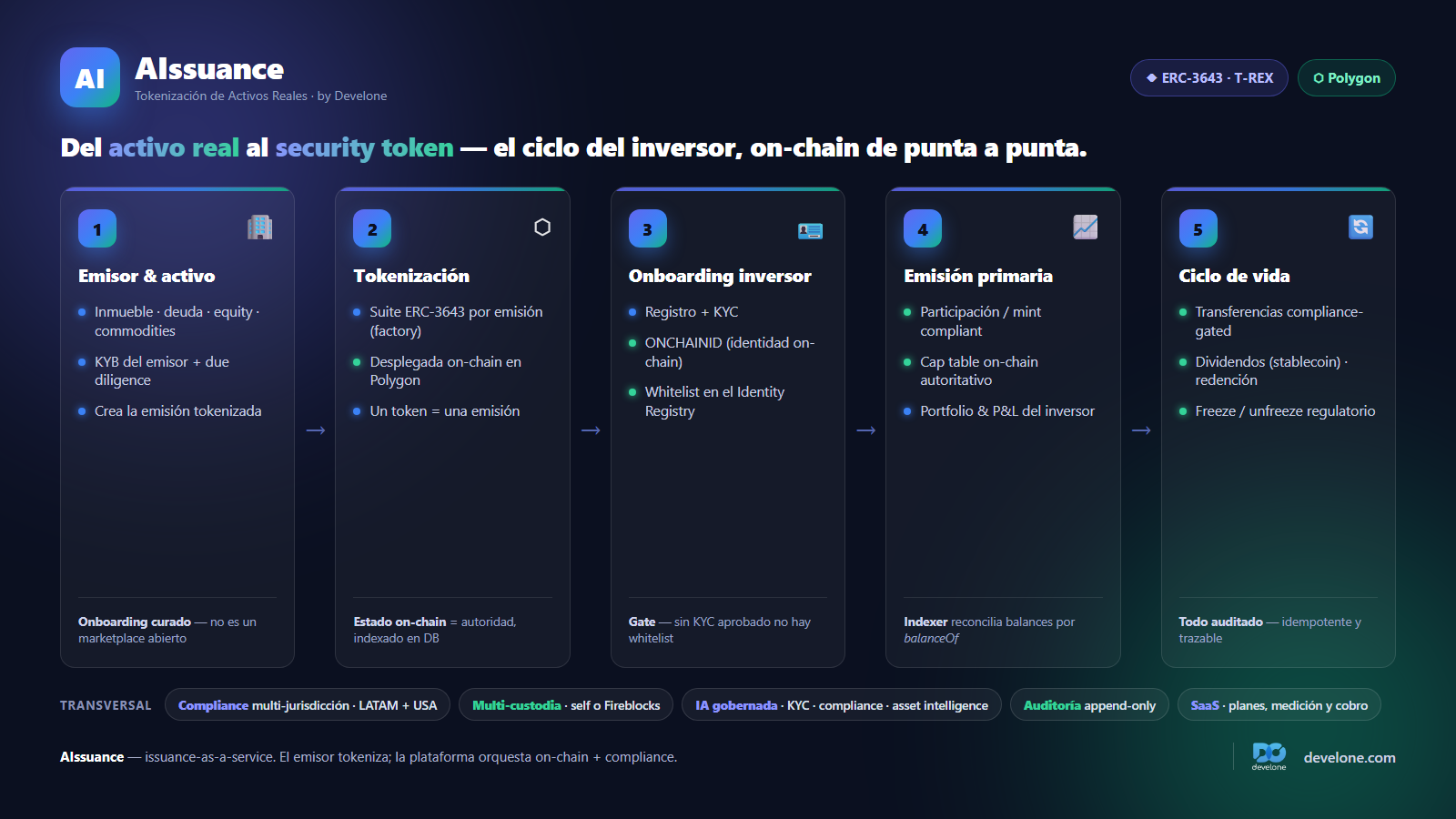
AIssuance (*AI + issuance*) is a real-world asset tokenization platform built on ERC-3643 security tokens (Tokeny's T-REX) over Polygon. It gives the issuer the software to issue, manage and pay instruments backed by real assets —real estate, debt, equity, commodities and environmental assets— and gives their investors a portal to subscribe, hold and get paid.
Live in production: investor portal at `rwa.develone.com`, issuer back-office and API, with an ERC-3643 issuance deployed on Polygon mainnet.
What it is
A B2B2C issuance-as-a-service SaaS: the issuer creates a tokenized offering, investors onboard (KYC + whitelist), subscribe to the primary issuance, hold their position and track their portfolio. The platform orchestrates the full lifecycle —on-chain and off-chain— and per-jurisdiction compliance. AIssuance is the software, not the asset: the issuer is the legal party behind the instrument.
Investor lifecycle, end to end
- KYC onboarding — the investor starts verification and uploads documents from their own portal; the issuer decides, and every decision is audited.
- Subscription agreement — platform-generated PDF with a content hash and auditable acceptance (timestamp, IP, user-agent) gated behind two-factor.
- Self-service wallet with proof of possession — the investor declares their wallet by signing an EIP-4361 message. Without the signature anyone could declare a third party's wallet and the mint would land there. A wallet already whitelisted, frozen or holding tokens is never auto-replaced: it escalates to the issuer, who de-registers the old address from every Identity Registry before the row changes.
- Settlement — non-custodial on-chain USDC: a forwarder contract with no owner and no withdraw moves funds from investor to treasury in the same transaction. No withdraw surface, no theft surface.
- Primary issuance, cap table and ledger — mint against the holding, transaction ledger and a live cap table.
- Compliance-gated transfers — only between wallets authorized in the Identity Registry, validated on-chain.
- Dividends and coupons — corporate action → distribution pro-rata over circulating holdings (not total supply) → on-chain stablecoin execution → settlement reconciled against the chain. Every step behind a state guard, 2FA and an audit entry; one failed payment does not abort the run.
- Holding certificate — a PDF the investor downloads from the portal.
- Redemption — investor-initiated, 2FA-gated, with buy-back and position write-down.
- Freeze / unfreeze — issuer compliance action on a holder.
Compliance, custody and key control
- ERC-3643: Identity Registry plus compliance modules (lock-ups, holder caps, per-investor maximums, freeze, court-ordered force transfer). Every transfer is validated against the on-chain registry.
- ONCHAINID — the investor's on-chain identity, with KYC bound to it.
- Multi-custody — self-custody or managed custody (Fireblocks), with signing outside the application server.
- Mandatory second factor on everything that moves value: mint, transfer, freeze, redemption, distribution execution and agreement acceptance.
- Multi-tenant with database RLS: each issuer sees only its own data; the platform role gets a read-only cross-tenant view.
- Observability — metrics on both services, and alerting that tells "RPC down" apart from "indexer dead", which are indistinguishable without it.
Valuation with provenance
An append-only valuation series: multi-source ingest aggregated by median, provenance recorded per data point, a circuit breaker on anomalous jumps and an SSRF guard on the sources. Changes are pushed live to the front end. A valuation is never corrected in place — a new one is appended and the previous one stays.
Sustainability-linked bonds (carbon-linked / SLB)
Debt whose coupon depends on a verified environmental outcome — not a carbon credit, a financial instrument with a KPI inside it:
- Projects and targets (SPTs) carry the project's own unit of measure (tCO2e, tonnes disposed, tonnes recycled, MWh). Measurements in different units cannot be summed, and the engine refuses before the coupon is computed.
- MRV with mandatory evidence: the evidence hash is computed server-side over the stored bytes; the client-supplied hash is only a cross-check.
- Third-party verifier (VVB) as a first-class role: the issuer no longer accepts its own MRV data. Each verifier's scope derives from its assignment to the project — it is data, not a permission flag.
- Coupon derived from the evaluated target, with the evaluation frozen alongside its inputs: a period counts once, and only verified data counts.
On-chain evidence anchoring
The evidence hash is sealed on Polygon and stays verifiable without depending on us:
- Public, unauthenticated verifier by hash, and a PDF receipt that carries its own verification URL and the hash in the clear.
- Anchored sources: MRV evidence, accepted subscription agreements and disposal certificates.
- Scope stated on the receipt itself: it proves existence and integrity of the document, not its truthfulness and not an audit.
Physical traceability — final disposal
The link underneath the MRV, for environmental assets:
- Typed certificate — batch, waste stream, classification code with its catalogue (Argentina's Law 24.051, the Basel Convention, EWC/LER — "Y9" alone is ambiguous) and tonnage; with a full weighbridge record the net weight is computed by the database (gross − tare) and the declared figure is only a check.
- Chain of custody as ordered steps —origin, transport, transfer, treatment, disposal— each link with its timestamp, responsible company, permit, plate, manifest and weighing. A transhipment with two hauliers is the normal case, not an exception to bolt on.
- Append-only: the batch is editable while the truck is moving; once closed, the row and its chain are frozen by trigger. Never the driver's personal data — identity travels as company data.
Audit
Every transition touching money, compliance or evidence writes to the issuer's audit log —who, when, old value and new— even when the actor is an external verifier with no tenant. Free text is never copied into the log: it is a PII candidate.
Governed AI (inside the product)
- Asset intelligence (asset copy and analysis drafts), compliance copilot, KYC assistance and investor Q&A.
- Hard governance: no PII or keys to the model, human-in-the-loop on compliance and KYC, every AI action audited.
SaaS model
Usage-based plans (issuances, tokenized volume, investor count, AI features) with metering, per-plan limits, checkout and invoicing. Curated onboarding: issuer KYB and asset due diligence before an offering goes live.
Status
Live in production with an ERC-3643 issuance on Polygon mainnet. 50 versioned migrations with their rollback verified against Postgres 16, and ~900 automated tests across API, chain service and contracts. On the path to operating at volume: external contract audit and activation of the KYC, payment and managed-custody providers.
Stack
ERC-3643 (T-REX) · Solidity + Hardhat · Polygon (ethers v6) · TypeScript · Next.js · Fastify · PostgreSQL with RLS · Fireblocks · Claude (in-product AI).